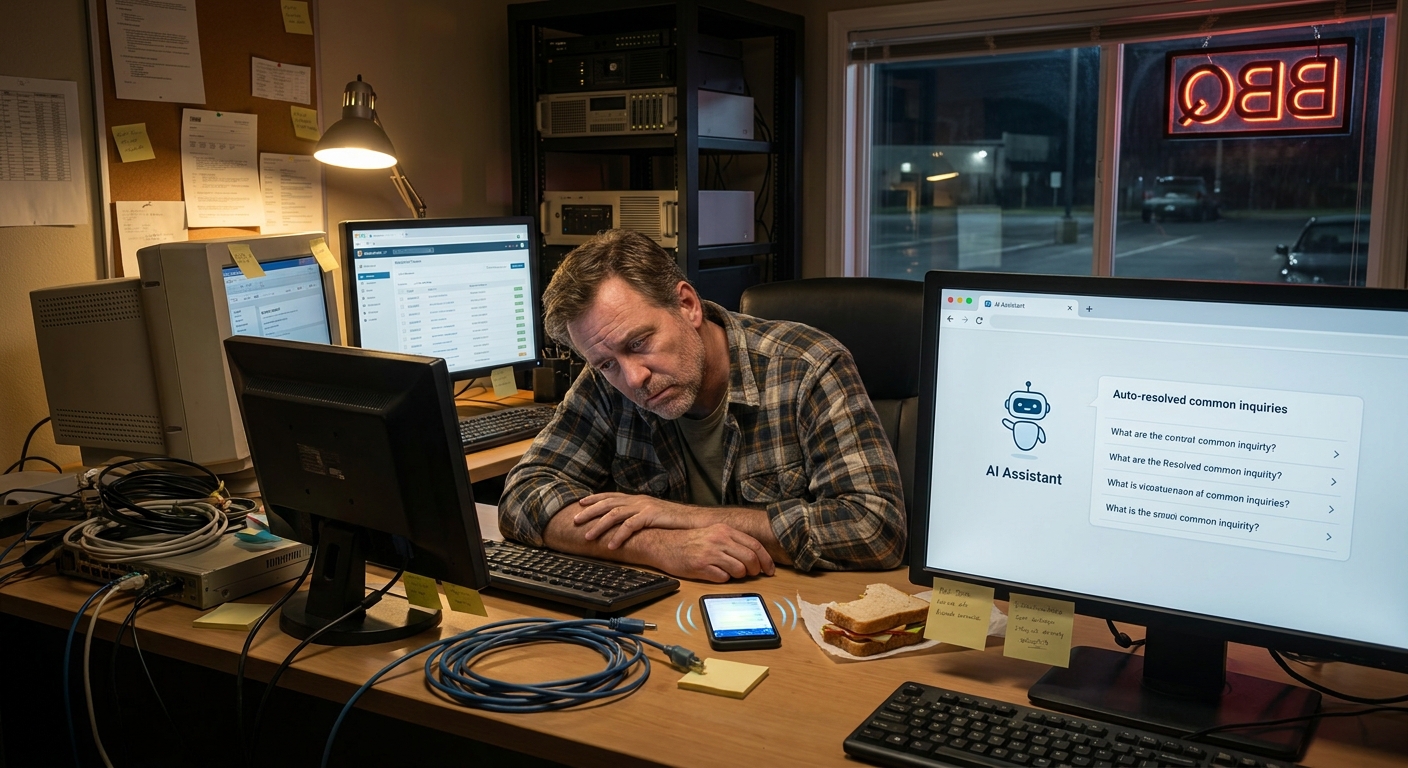
I was standing in line at Shealy’s BBQ in Leesville the other night, watching the line snake past the sweet tea station, when a buddy of mine from Lexington waved me over.
“Man,” he said, “if I answer one more ‘What’s your pricing again?’ email, I’m gonna lose it.” He runs a small home services company, nothing crazy. But his phone buzzed three times in the 5 minutes we talked. Same kind of questions. Same back-and-forth. Same interruption.
That’s what got us talking about AI self service automation workflows for clients… right there between the hush puppies and the banana pudding.
So, Here’s the Deal
Most small businesses around here are stuck in the same loop:
- Clients call asking the same 5 questions.
- You stop what you’re doing to respond.
- Your day gets chopped into a hundred tiny pieces.
It’s not that you mind helping people. That’s kinda the fun part. It’s that doing it the same way all day long is killing your focus. And honestly, it’s slowing your clients down too.
That’s where ai workflow automation for small business actually makes sense. Not the big fancy stuff. Simple, self-service tools that let your clients help themselves… without feeling like they’re stuck talking to a robot that doesn’t “get” them.
The Part Most Folks Miss
When people hear “AI,” they picture some weird, cold system taking over their business. That’s not what I’m talking about.
Here’s what I mean by business tasks you can automate with ai workflows for self-service:
- Stuff that’s boring to repeat.
- Stuff that doesn’t need your expert brain every time.
- Stuff clients want answers to right away, even at 10:43 pm on a Sunday.
Think:
- “What are your hours?”
- “Do you serve my area?”
- “How much is a basic service?”
- “How do I reschedule?”
- “What should I do to prep before you arrive?”
Those don’t need your full attention every time. They just need to be accurate, friendly, and fast.
Let’s Keep It Simple
Let’s walk through some easy ai self service automation workflows for clients you can set up without turning your whole business upside down.
1. A Helpful Website Chat That Actually Knows Your Business
Not the generic “Hi! How can I help you today?” thing that never helps. I mean a chat box that:
- Understands your services, prices, and service areas.
- Can answer FAQs the way you’d say it.
- Can hand off to you (or your team) when things get complex.
Basic workflow could look like this:
- Client lands on your website from Google or Facebook.
- AI chat pops up and asks a simple, direct question: “Hey, want a quick price estimate or need to ask a question?”
- If they pick “price estimate,” it asks for:
- Location
- Service type
- Rough size / scope (tiny, medium, big job)
- AI gives a clear estimate range plus a button: “Book a visit” or “Text us if you’d rather talk.”
Client gets answers fast. You get fewer “Hey, just checking, what do you charge?” calls while you’re on a ladder or in the truck.
2. Text-Based Self-Service for Your Regulars
Quick tangent: earlier this week in Columbia, I watched a woman at a car wash text to start the whole wash process. No app, no login. Just a simple text menu. And it got me thinking… why aren’t more small businesses doing that?
You can set up a text number where clients can:
- Check appointment time.
- Reschedule or cancel.
- Get directions or parking info.
- Get a simple status update (“Is my order ready?”).
Workflow might be:
- Client texts your number: “Need to reschedule.”
- AI looks up their phone number in your calendar system.
- It replies: “Got it, you’re booked for Thursday at 2 pm. Want to move it? Here are 3 options:”
- Client taps one option, workflow updates calendar, sends confirmation.
You don’t touch a thing. But it still feels personal because it’s all based on their info and your rules.
3. Self-Service Intake Forms That Don’t Feel Like Homework
You know those long, annoying forms some places send? The ones nobody wants to fill out? We can make that less painful with AI.
Instead of a giant form, let AI guide people through step-by-step:
- Ask one simple question at a time.
- Explain why you’re asking it.
- Auto-fill stuff if they’re a repeat client.
Example for a local HVAC company in Greenville:
- Client clicks “Schedule a tune-up.”
- AI asks: “Is this your first time with us?”
- If yes: “Cool. What kind of system do you have? Not sure? That’s ok, just pick what looks closest.”
- AI uses their answers to:
- Route them to the right tech.
- Estimate how long the visit will take.
- Prep a short checklist for your tech before they arrive.
Client feels guided, not dumped into a pile of boxes to check.
4. Self-Serve “Where’s My Stuff?” Updates
If you handle projects, repairs, or orders, this one’s huge.
Let clients check status on their own:
- Order status (“We’re waiting on parts, eta Friday.”)
- Project stage (“We’re in design review.”)
- Payment status (“Your last payment went through, thanks!”)
Workflow example:
- Client clicks a link from your email or text.
- They enter phone number or invoice number.
- AI pulls status from your system and:
- Shows current stage.
- Explains what that stage means in plain English.
- Tells them what happens next and when.
That alone can cut a ton of “Just checking in…” messages.
A Quick Story from the Road
I was driving back from Wilmington one afternoon, stuck on 74 behind some guy hauling a boat that looked way too big for his trailer. Phone buzzes. It’s a landscaper I know out in North Charleston.
He goes, “Man, I’m losing an hour a day just texting people back about weather delays.”
So we set up a simple AI workflow:
- He updates one note in his system when rain messes up the schedule.
- AI sees the change.
- It auto-texts each affected client:
- Explaining the delay.
- Offering 2 new time slots.
- Letting them pick by tapping a number.
Clients loved it. Nobody felt ignored. Nobody had to chase him. And he got his evenings back.
He told me, “I used to dread rainy days. Now it’s just a few clicks.”
I don’t know everything, but that right there is the kind of small win that adds up fast.
Here’s the Game Plan
If you’re thinking, “Ok, but where do I even start?” here’s a simple way to ease into ai workflow automation for small business without getting overwhelmed.
Step 1: List Your Top 10 Repeat Questions
Not every question. Just the ones you feel like you answer every single day.
- Grab a notepad (or the back of a Harris Teeter receipt, been there).
- Write down the questions as your clients would say them.
- Write your best, clearest answer next to each.
Step 2: Pick ONE Place for Self-Service
Don’t do website + text + email + chat all at once. Just choose one:
- If people always hit your website first → start with a simple chat.
- If they love texting you → start with a text workflow.
- If email is your thing → start with an auto-reply that actually helps.
Step 3: Keep It in Your Voice
Write your answers like you talk. If you say “y’all” in person, it’s ok to say it in your messages. If you joke around with customers, let a little of that show through.
The AI isn’t there to sound like a Silicon Valley robot. It’s there to sound like your front desk on their best day.
Step 4: Set Clear “Hand-Off” Rules
This part’s big. You don’t want AI pretending to be you when it’s out of its depth.
Set rules like:
- If the client sounds upset → send to a human.
- If the question is about refunds → send to a human.
- If the client uses words like “urgent,” “emergency,” or “ASAP” → send to a human.
That way, AI handles the easy stuff, and you handle the parts that really need your touch.
The Honest Truth
Here’s where most people get stuck: they think if they add self-service, their clients will feel brushed off.
But think about your own life. If you’re standing under the live oaks in downtown Charleston, trying to figure out where to park, do you want to call someone and sit on hold… or tap a link and see clear directions in five seconds?
Clients want the same thing: fast, clear answers when the question is simple. A real human when things get messy.
Done right, ai self service automation workflows for clients aren’t about replacing you. They’re about letting you show up where you matter most… and letting the boring stuff handle itself.
Something to Think About
Next time you’re stuck in line somewhere around here — maybe at Bojangles off Two Notch Road or waiting at the light by the Ravenel Bridge — ask yourself one question:
“What’s the one question my clients asked me today that I never want to answer manually again?”
Start with that one. Build a tiny workflow for it. See how it feels.
If it saves you even 15 minutes a day, that’s over 90 hours a year. That’s a lot of evenings you get back. A lot of games, walks, sunsets on Folly, whatever your thing is.
And if you want help turning those repeat headaches into simple, friendly self-service workflows, well… that’s kinda what I do. No pressure. Just know you don’t have to keep doing everything the hard way.